The Ultimate Guide to India’s Golden Triangle Tour – Delhi, Agra & Jaipur
Introduction: Where every journey through India begins
Close your eyes for a moment. Picture the haunting echo of the azaan drifting over the rooftops of Old Delhi at dawn. The soft pink light falling on white marble as the Taj Mahal materialises through the morning mist. The warm glow of Rajasthan’s sandstone forts turning amber in the late afternoon sun. This is India’s Golden Triangle — and it has been stopping travellers in their tracks for centuries.The Golden Triangle Tour is a roughly 720-kilometre road circuit connecting three of India’s most extraordinary cities: Delhi, the ancient and modern capital; Agra, home to the world’s most recognisable monument; and Jaipur, the jewel-bright Pink City of Rajasthan. Together, they form what is widely considered the single best introduction to the Indian subcontinent.This guide is for you if you are visiting India for the first time, have limited time and want to make every day count, or simply want to see the country’s Mughal grandeur and Rajput splendour in one seamless trip. By the end of this post, you will know exactly what to see, when to go, how to get around, what to budget — and how to book a curated Golden Triangle package through Ghummofy so you can leave the logistics to us.
What is the Golden Triangle tour?
The Golden Triangle gets its name from the triangular shape formed by its three cities on the map. Delhi sits at the top, Agra to the south-east (roughly 200 km away), and Jaipur to the south-west (about 270 km from Delhi and 240 km from Agra). The three cities form a neat loop that can be driven, trained, or flown in any order — though Delhi → Agra → Jaipur → Delhi is the classic and most practical sequence.
What makes this circuit so compelling is the way it compresses Indian history into a few intense days. Delhi carries the layered imprints of seven successive empires. Agra was the Mughal Empire’s beating heart for over a century. Jaipur was founded in 1727 as one of India’s first planned cities and remains the capital of Rajasthan. Together they represent Mughal power at its zenith, Rajput warrior culture at its most refined, and modern India at its most vibrant.
| Ghummofy offers fully-managed Golden Triangle tour packages for solo travellers, couples, families and groups — with private cabs, hand-picked stays and a local guide at every stop. Explore our packages at ghummofy.com |
Delhi: Where ancient and modern India collide
India’s capital is a city of stunning contradictions. Medieval mosques stand beside glass office towers. Auto-rickshaws weave between luxury SUVs. Street vendors selling chai for ₹10 operate in the shadow of five-star hotels. For first-time visitors, Delhi can feel overwhelming — but that sensory overload is precisely the point. This is a city that has been at the centre of Indian civilisation for over three millennia, and it shows.
Must-see sights in Delhi
- Red Fort (Lal Qila) — Shah Jahan’s magnificent red sandstone citadel, a UNESCO World Heritage Site and the symbolic heart of Indian sovereignty. The Sound and Light show in the evenings is not to be missed.
- Qutub Minar — The tallest minaret in India at 73 metres, built in the 12th century. The surrounding ruins complex is UNESCO-listed and far less crowded than the Red Fort.
- Humayun’s Tomb — Often described as the architectural prototype for the Taj Mahal, this Persian-influenced mausoleum is serene, photogenic and wonderfully peaceful.
- India Gate & Kartavya Path — The 42-metre war memorial and the grand ceremonial boulevard that leads to Rashtrapati Bhavan. A favourite for an early morning or evening stroll.
- Chandni Chowk — Old Delhi’s legendary bazaar: a dense, aromatic maze of spice markets, silver jewellers, street food stalls and wedding shops. Hire a cycle-rickshaw and let someone else navigate the chaos.
Delhi travel tips
Recommended time: 1.5 to 2 days
Best area to stay: Connaught Place for central access; Aerocity for those arriving on late-night flights; Paharganj for budget travellers.
Getting around: Delhi Metro is clean, fast, air-conditioned and affordable. Use it liberally. Save autos and cabs for areas not on the metro map.
Food to try: Butter chicken and dal makhani at any good Punjabi dhaba; chole bhature in Karol Bagh; paranthe wali gali in Old Delhi for breakfast; kulfi at Roshan Di Kulfi.
Agra: City of the Taj Mahal
If there is one image that the world associates with India, it is the Taj Mahal. But Agra offers far more than its most famous monument. This city on the banks of the Yamuna river was, for much of the 16th and 17th centuries, the capital of the Mughal Empire — and the wealth, artistry and imperial ambition of that era is written into every stone here.
Must-see sights in Agra
- Taj Mahal — Words do not do it justice. The white marble mausoleum built by Emperor Shah Jahan for his wife Mumtaz Mahal between 1632 and 1648 is one of the greatest architectural achievements in human history. Visit at sunrise for the softest light and the thinnest crowds. Entry is through the South Gate or the East Gate.
- Agra Fort — A short drive from the Taj, this UNESCO-listed red sandstone fortress is where Shah Jahan spent the last years of his life imprisoned by his own son — with a view of the Taj Mahal across the river. The palaces inside are extraordinary.
- Fatehpur Sikri — About 40 km from Agra, this perfectly preserved Mughal ghost city was Emperor Akbar’s capital for just 14 years before being mysteriously abandoned. Its empty courtyards and stunning architecture are haunting and unforgettable.
- Mehtab Bagh — Directly across the Yamuna from the Taj, this garden was originally designed as a mirror to the Taj complex. It is now one of the best — and least crowded — spots for a sunset view of the Taj’s famous silhouette.
Agra travel tips
Recommended time: 1 full day; overnight if you want both a sunset and sunrise at the Taj.
Delhi to Agra: The Gatimaan Express is the fastest option at 1 hour 40 minutes. By road via the Yamuna Expressway takes around 3.5 to 4 hours.
Taj Mahal entry fees: ₹50 for Indian citizens; ₹1,300 for foreign nationals (includes entry to the main mausoleum). Book tickets online in advance at asi.payumoney.com to avoid queues.
Shopping: Agra is famous for marble inlay work (pietra dura), leather goods and Mughal-era recipes in the bazaars near Taj Ganj.
| Watch out: Touts near the Taj Mahal gates will offer to take you to ‘free viewing points’ or ‘government shops’. These are invariably scams. Buy tickets only at the official ASI booths or online. Ghummofy packages include pre-booked Taj Mahal entry tickets to keep your day smooth. |
Jaipur: The Pink City of Rajasthan
No Indian city announces itself quite like Jaipur. The moment you enter the walled Old City, the terracotta-pink colour that covers every facade — mandated by a royal decree in 1876 to welcome the Prince of Wales — hits you like a warm wave. Add the turbaned shopkeepers, the camel carts, the scent of rose water and the dazzle of gemstone jewellery in every shop window, and you have the most visually distinctive city in India.
Must-see sights in Jaipur
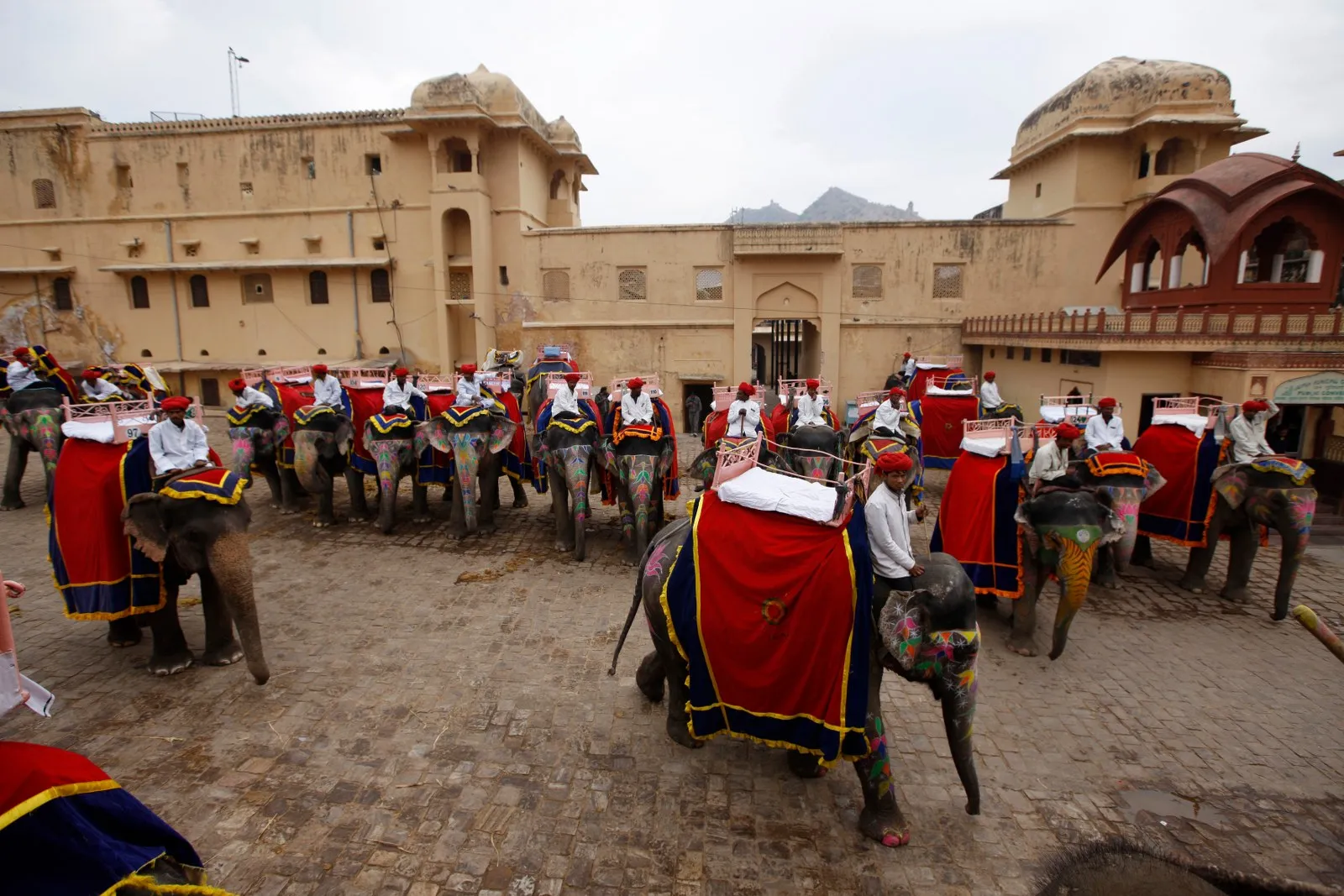
- Amber Fort — Perched on a hill 11 km from the city, this breathtaking Rajput fort-palace is Jaipur’s undisputed highlight. Arrive early to beat the tour groups. The Sheesh Mahal (Hall of Mirrors) inside is genuinely astonishing.
- Hawa Mahal — The five-storey ‘Palace of Winds’ with its 953 windows is one of the most photographed facades in Asia. It was built in 1799 so royal women could watch street festivals from behind the latticed screens without being seen.
- City Palace — Unlike most Indian palaces, the City Palace is still partially inhabited by the royal family of Jaipur. The museum section is excellent and gives a vivid picture of Rajput court life.
- Jantar Mantar — A UNESCO World Heritage Site sitting quietly in the heart of the city, this 18th-century astronomical observatory contains the world’s largest stone sundial, accurate to within two seconds. Strangely beautiful.
- Nahargarh Fort — For the best sunset view over the pink-hued city, take a cab up to Nahargarh. Arrive 45 minutes before sunset, find a spot on the ramparts and watch the whole of Jaipur turn golden.
Jaipur travel tips
Recommended time: 1.5 to 2 days
Agra to Jaipur: Around 240 km by road, roughly 4.5 hours depending on traffic. Several direct trains also connect the two cities via Bharatpur.
Shopping: Jaipur is India’s capital for precious and semi-precious gemstones. Also famous for block-printed textiles, blue pottery, lac bangles and hand-stitched leather shoes (mojris). The bazaars of Johari Bazaar, Bapu Bazaar and Tripolia are the best hunting grounds.
Food to try: Dal baati churma (the definitive Rajasthani dish), laal maas (fiery red mutton curry), kachori with sabzi for breakfast and ghewar (a disc-shaped sweet) if you visit between July and October.
Golden Triangle itineraries: 5 days and 7 days
The Golden Triangle works well over 5 days for a focused, highlights-led trip or 7 days for a more relaxed pace that allows you to breathe in each city properly. Both options below are available as curated packages on Ghummofy.
5-Day Itinerary
| Day | City | Highlights | Accommodation |
| Day 1 | Delhi | Red Fort, Chandni Chowk, Jama Masjid, street food dinner | Connaught Place hotel |
| Day 2 | Delhi | Qutub Minar, Humayun’s Tomb, India Gate, evening shopping at Dilli Haat | Connaught Place hotel |
| Day 3 | Agra | Drive/train to Agra, Taj Mahal at dusk, Agra Fort, Agra street food | Hotel near Taj Mahal |
| Day 4 | Jaipur | Drive to Jaipur via Fatehpur Sikri, Amber Fort, Hawa Mahal | Old City / heritage hotel |
| Day 5 | Jaipur | City Palace, Jantar Mantar, local markets, departure | — |
Frequently asked questions
Is 5 days enough for the Golden Triangle? Yes — 5 days is enough to cover the major highlights of all three cities. 7 days gives you breathing room and the chance to see Fatehpur Sikri and more of Agra.
Can I do the Golden Triangle without a guide? Entirely possible, especially in the age of Google Maps and online reviews. That said, a good local guide at each stop — the kind Ghummofy partners with — adds layers of context, history and access that independent travel simply cannot replicate.
Is the Golden Triangle good for families with children? Excellent. The cities are well set up for families, and children tend to be captivated by elephant rides at Amber Fort, the scale of the Red Fort and the Taj Mahal. Ghummofy offers family-specific packages with child-friendly pacing.
Is it wheelchair accessible? The newer parts of Delhi Metro and most 4-star+ hotels are accessible. Many historical monuments involve steps and uneven surfaces. Contact Ghummofy directly and we will plan an accessible itinerary.
What is the best photography spot at the Taj Mahal? The central pool reflection (arrive first thing for the smoothest water), the back garden above the Yamuna for a frame without tourists, and Mehtab Bagh across the river for the complete silhouette at sunset.
Ready to Experience the Incredible India?
Get a personalised India Tour Package — Taxi Services, Hotel Booking ,Tour Packages & more.
We’re based in Jaisalmer. We answer every enquiry personally, usually within 2 hours.